Mental Health Swims - My First Hosted Open Water Swim
About a fortnight ago, the Mental Health Swims (MHS) account followed me on Instagram, and within moments I was shooting the Founder, Rachel, a DM.
I couldn’t believe that I was seeing a model that was a mirror refection of Run Talk Run (RTR) but for open water swimming. The premise and goal is the same - facilitate a safe space where people can turn up entirely as themselves, whether they are happy, sad, anxious or meh. Normalising mental health conversation at the forefront, with an activity as a secondary bonus feature. RTR for running, MHS for swimming.
Unlike RTRs weekly regularity, MHS meet to swim just once a month which lowered the barrier to participation and hosting, since I wasn’t entirely sure that I could commit to a weekly swim. Fast forward about a week or so, and Rachel and I are chatting endlessly over the phone about our dreams and plans for both RTR and MHS.
I answered some of her questions about what it takes to scale such a beastly support community. We talked about the boring Health & Safety stuff, the logistical sign-up process stuff, and then we bonded over the emotional labour that we pour into these communities and the need for boundaries. If I wanted Rachel to come away with anything, it was to know that the boundaries she puts in place now will be the very lines with which she’ll save herself when MHS undoubtedly scales into something even more magnificent than what it is today.

So how was that first swim?
SCARY.
I have to admit that over the last 3 years I’ve developed a pretty solid routine around my RTRs that make them easier to navigate as a leader. What I mean by this, is that my confidence has grown.
Hosting this MHS for the first time, however, had me swimming in discomfort in the days prior… what would I say? What if a really competent swimmer turned up and I couldn’t facilitate their needs? What if my social anxiety flared up and I lost all communication skills in an instant? What if they could smell the sadness on me, and it was all too much?
It was like I’d been thrown back 3 years and I felt a wave of empathy for all the new RTR Leaders who show up to their runs in the first few weeks so deeply unsure of their right to be a “running leader”.
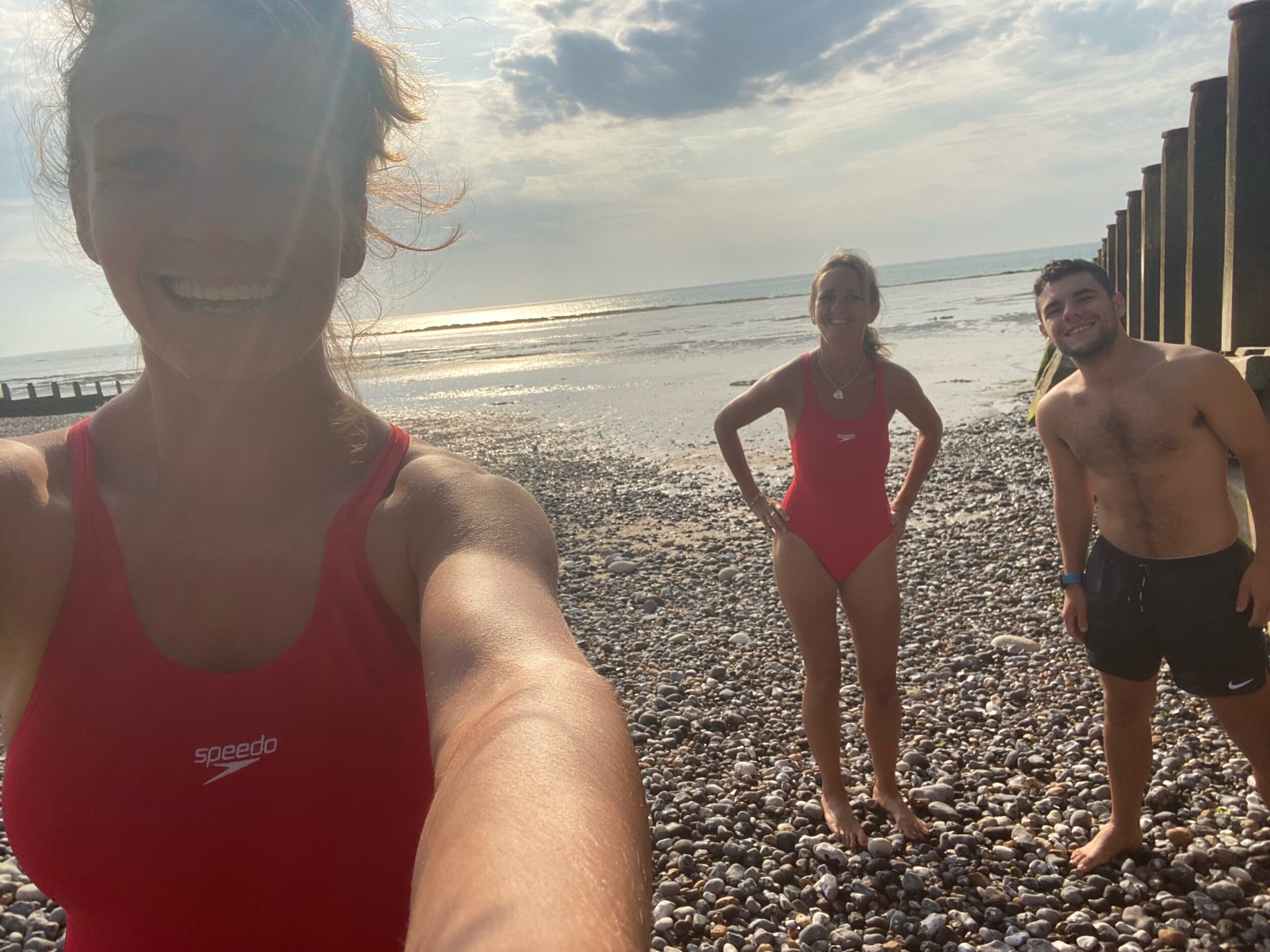
In the end, it was just my mum and boyfriend who came along for the dip and so any social pressure was alleviated immediately. I also massively messed up with tide times and so I felt incredible gratitude for the fact no strangers had seen this cock up!
So between Jake, my mum and I, we splashed in the shallow rock pools and slipped around on the seaweed and laughed at each other as we fell into deeper parts of the sea unexpectedly. We didn’t talk mental health…. but I could bring my most “Jess self” there and that was special.
Instead of hosting these monthly I think I’m going to hold them weekly. I want to build my confidence with open water swimming, and I want to build my confidence in facilitating a support group outside the realms of RTR too.
The world deserves mental health support that is accessible, and less intimidating than sitting in a circle raising our hands to share what little parts of sadness we can bare to expose. It’s up to us, your Average Joe’s, to make sure we are creating spaces where talking about your mental health is just so normal.
I think this is what I care about more than anything in the world… the running and the swimming… they’re just a lovely little bonus.
Join me next Sunday @ Holywell Toilets. Time to be confirmed - I’ll post it to my Instagram @jessicamaryrobson

Talking to Strangers - Happy To Talk Launch in John Lewis
What is Happy to Talk, and why is it being stocked in John Lewis?
On a very very chilly Wednesday evening this 4th December 2019, I headed to the John Lewis Sloane Square store… not to make a start on Christmas shopping, but to support Chris Zair in sharing the Happy to Talk campaign with JL customers and staff.

I say this so very often, but the best thing Run Talk Run has brought to my world, is the PEOPLE (like Chris and tonight meeting Lisa from Papyrus) who really give a shit about the same things that I do. Who really want to get people talking and supporting each other.
So what is Happy to Talk?
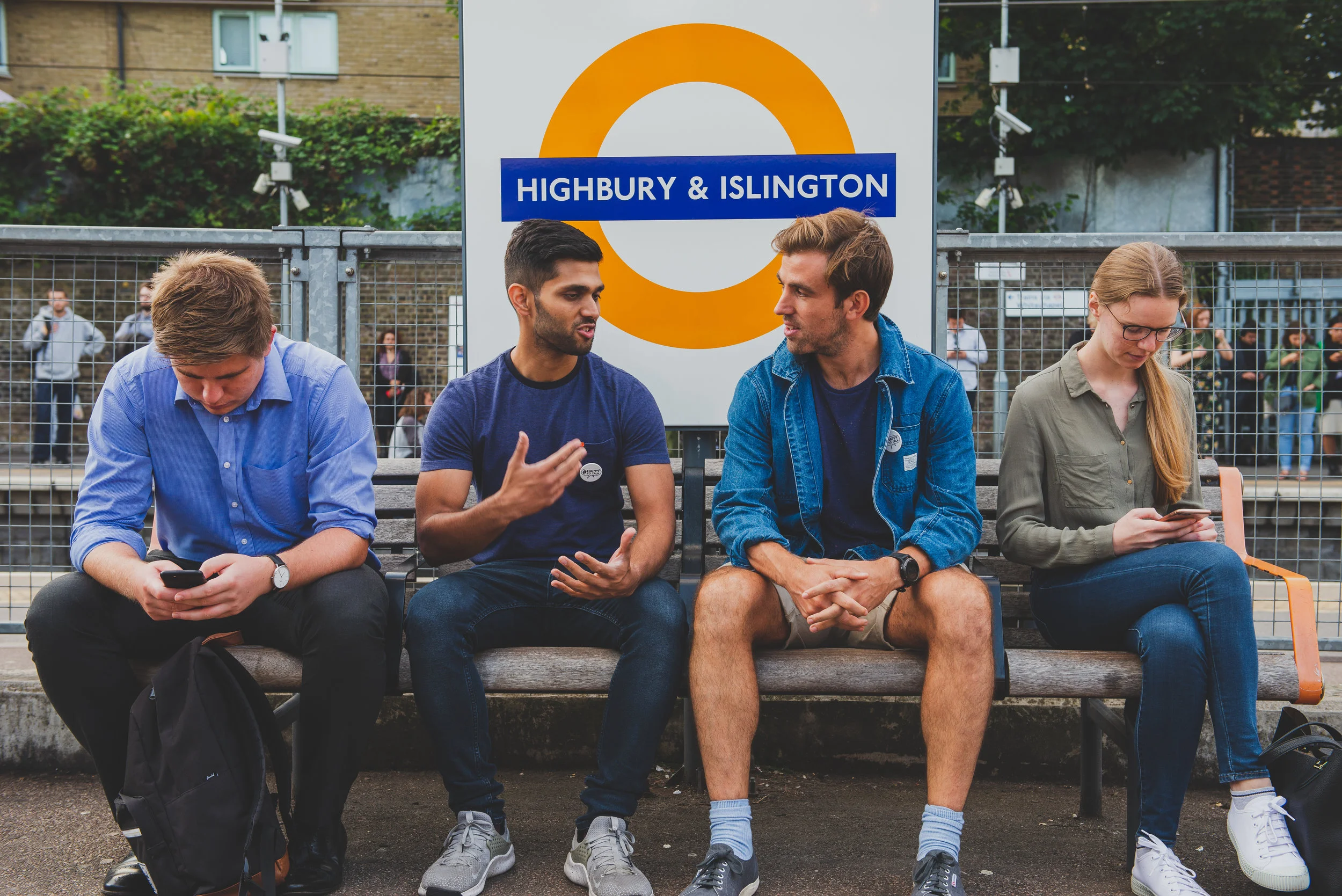
It is a social movement, encouraging people to talk on London’s public transport. Instead of sticking your earphones in and shutting the world out, Happy to Talk is about inviting connection in. It is about acknowledging the people around you, sharing a smile, giving a nod to a passerby. In a world that is so digitally connected, we appear to have lost the art of offline connection. Happy to Talk is the counter to that.
I wrote a post about why it is important to talk to strangers a little while ago, which gives more depth to the HTT campaign.
John Lewis Sloane Square are now stocking the badges to assist us in spreading the word about talking to strangers and creating a more connected London!

IT DOESN’T GET EASIER...
but it is always always always worth speaking in public not just about RTR and what we are doing, supporting our peers on our weekly runs… but actually to talk about my own journey TO creating Run Talk Run in the first place.
My voice cracked and my hands shook this evening as I tried to sputter something coherent about running and talking. Truth be told, I still get very emotional. It all means so much to me. I’ve accepted that this is all part of the public speaking experience for me and I won’t let it stop me continuing to talk.

SO, thank you Happy to Talk for supporting our amazing community. (£2 of every sale of a HTT badge is donated to RTR). You can buy your badge directly through the Happy to Talk website, or in the John Lewis Sloane Square store.
I am a Confidence Coach, and I currently have 1:1 sessions available to book in for 2020. If you would like to ask me any questions about this coaching, feel free to drop me a line. Or you can book in to have some time on the phone with me (for free, obvs).
We need to be talking to strangers
What we can learn from having ‘real life’ conversations with strangers is far more valuable than anything ‘digital’.
In the summer of 2018 I was recommended a book by my good friend Tom Haswell. I had zero expectations upon starting this book, I honestly thought to myself that it would be just yet another self-help-fix-yo'self-sort. I was nervous about the fairly controversial stance that the author took on anti-depressants, and I was in a good place mentally so didn't see the need for any more depression material.
This book, 'Lost Connections', was gobbled up by my eyes in less than 48 hours.
To say this is a controversial text would be an understatement, and there are a few things that I disagreed with when reading the book. If anti-depressants alleviate a persons symptoms of depression then I see no harm being caused by taking medication. But that's another blog for another day. This is about connection and talking to strangers.
The author Johann Hari depicts a story of depression being caused primarily by a lack of "connection", and the book is split neatly into the varying forms of connection that we are likely to be missing out on.
We are more digitally connected than we have EVER been. Having "insta-friends" is quite the norm, and it's easier than ever to ping your mum a Whatsapp every day instead of rustling up enough free time in your diary to pop round for a cuppa.
But the result of all this... communicating... is that ironically, we're not communicating at all. Not really. Not with our mouths and our eyes and our bodies.
We jump onto the tube and stick our heads into our phones, scrolling for the right playlist to take us to work, or shutting our eyes as we absorb another podcast about what (ironically) will make us a happier human.
What Johann argues is that we need to be interacting MORE with the people in our immediate community and just engaging in our environment.
I've felt the benefits of face-to-face communication, community, and consequently, connection, through running with the same group of gorgeous Run Talk Run pals every Thursday evening. But my positive experience with Run Talk Run, and reading this bloody awesome book has left me craving just more and more of that communication with the people around me.
I tried it in small doses at first. You know... actually SMILING at passersby, or actually making a comment out loud if I see something of interest whilst waiting at the bus stop with strangers. The shared "moment" is indescribably fulfilling, even if just for a moment. Even if it is just to acknowledge the mouse that has run by both of your feet. That is a moment shared between you and another human, and that feeling of "connecting" does us a tonne of good.
There is SO much to be learned from strangers. Even if we've grown up in the same area as another human, our experience of life will have been miles apart and that presents such a beautiful opportunity to learn and grow and develop.
Anyway, as I have been continuing to push past the discomfort and thoughts of
"what if they just stare blankly back at me"
or worse, what if they ridicule me
I have been presented with an opportunity to work closely supporting the amazing Chris Zair as he launches his new #HappyToTalk campaign.
The #HappyToTalk movement is selling badges to people who are willing to invite a smile and a friendly conversation into their world, whilst traveling around on public transport and going about their daily activities.
A decision to not stick your earphones in. Even if just for one commute a week. Even just for 5 minutes of your commute. Just to see what connection you might welcome into your world... what you might learn.
I am so very very excited to see just how massive this will become and I invite you to get yourself a badge and get on board with this talking to strangers malarkey. If not for your mental health, then for your "social health" as Chris so aptly puts it.
Buy your #HappyToTalk badge and get the conversation going.
Run Talk Run is not Group Therapy
Our mental health support group is not group therapy. This blog explains why.
I think that a lot of the time I focus really heavily on describing everything that Run Talk Run is.
It is easy to talk about what a supportive, community-focused, all-ability-welcoming, open and honest environment we are.
What is more tricky, or avoidable perhaps, is talking about what we are not.
But talking about what we are not, is super-duper important.
Talking about what we are not helps people distinguish whether or not we are really “right” for what they need.
Run Talk Run is not group therapy.
But why not?
The simplest way to answer this is to explain that group therapy would require a leading therapist.
Run Talk Run leaders are not therapists.
(well, actually, some are… but they are not acting as therapists in the RTR sessions).
Does that mean that Run Talk Run is not as effective as group therapy… with a “proper” therapist?
Well, yes and no. It’s the classic “it depends”. It depends what you class as “effective” for you, personally.
Run Talk Run holds the belief that we need more less intimidating spaces to talk about our mental health. To achieve the less intimidating vibe, we believe that the run leaders should be on an equal playing field as the runners who attend. Whilst they are the navigators of the run, and have a responsibility to ensure everyone is safe, they can also use the session to talk about their shit, and be honest about their mental health too.

Everyone is equal at Run Talk Run.
Irrespective of pace.
Irrespective of confidence.
Irrespective of age, gender, athleticism, whatever.

And that means that the Run Leaders are no more qualified than you are.
They are just people who give a shit about mental health. Like you.
Sometimes, Run Talk Run might feel like group therapy, because it is such an open environment. The nature of running (and knowing that it’s a confidential space) allows an element of letting go of what we might usually hold internally on a day to day basis. When we are not used to experiencing this level of openness, it can feel like what we can imagine therapy to be.
But the Run Leader (and runners themselves) are not there to pull these things from you, or to encourage you to dig deep for this revelation. They are simply there to listen to whatever it is you need to share.
We are a mental health support community. Not group therapy.
We are here to bridge the gap between not talking at all, and the opposite end of the spectrum of receiving professional talking therapy.
And, an important note to end on….
You do not have to be professionally qualified as a therapist to be an empathetic listener.
See you at a Run Talk Run soon I hope. Please do email me using the contact form if you have any questions.
The 5 Reasons Why Running Makes it Easier To Open Up
There is very good reason why I believe that running makes it far easier for us as humans to open up our true selves to one another. Here is why.
Run Talk Run was born out of three very basic principles.
People need spaces to feel heard and understood.
London needs a less intimidating running club.
Running is the BEST enabler for us to “open up” about our deep, dark, internal “shit”.
A few people have recently asked me WHY I think running is the easiest way to open up to other people. I suppose I have my own experience to base my answer on because I suppose it worked for me. But there is very good reason why I believe that running makes it far easier for us as humans to open up our true selves to one another. Here is why.

There are no social boundaries.
From the CEO in a Hedge Fund to the construction site labourer – running kit is running kit – everyone is on equal terms, and that cuts out a lot of the bullshit we see in the “real world”. It is like the social pre-judgements we make no longer apply once we’re out, pounding the pavements.
We are displaying our rawest selves.
Out running, we are showing ourselves at our most vulnerable. We are fatigued, sweaty, red, exhausted, uncomfortable. Experiencing that level of vulnerability at the same time as another human being creates a bond which allows us to be raw about other aspects of ourselves too.
Less intimidating.
Running side by side reduces the intimidating nature of eye contact. When you take away the eye-contact factor you are taking away that feeling of being judged. It is almost as though we are running and being honest with ourselves as much as we are being honest with the person running next to us. Knowing that the other person is at your side, instead of directly ahead of you means that you can move forward together. There is great power in that.
Getting outside.
In today’s world we are becoming less and less frequent in our “face to face” real-time communications with the people around us. Getting outside with one another for a run is one of the few opportunities that we really have to share what might sound somewhat “silly” or “dramatic” or simply too difficult to explain over a message or Whatsapp.
Lost inhibitions.
Whilst running, it is almost as though we are simply too tired to put up any pretences about who we are. I have definitely seen friends and family at their “most silly” whilst running, and I think that’s genuinely because it is simply impossible to maintain a decent level of composure. That loss of inhibition makes it so much easier to just let go of our fear of judgement, so it becomes easier to share what’s really on our mind.
I would be really interested to know/hear about any other theories of why it is easier to open up to another person whilst out running, more so than other social settings. Or perhaps you disagree! Let me know in the comments.